

Introduction to the Crisis
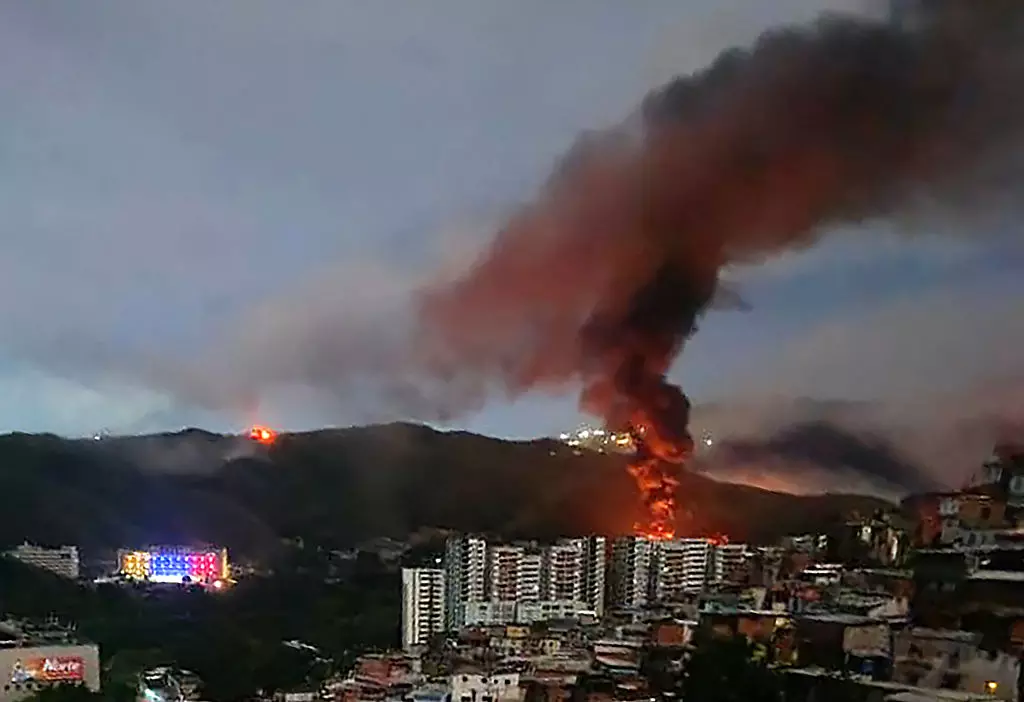
A series of explosions rocked Caracas, Venezuela, on January 3, 2026, with fires reported at Fuerte Tiuna, the country’s largest military complex. The incident has sparked a significant escalation in tensions between the United States and Venezuela. President Trump announced that the U.S. had carried out airstrikes in Venezuela, capturing President Nicolás Maduro and his wife.
The U.S. Operation
President Trump claimed in a post on Truth Social that the operation was conducted "in conjunction with U.S. Law Enforcement" and announced a news conference to provide further details. U.S. Attorney General Pam Bondi stated that Maduro and his wife, Cilia Flores, have been indicted on drug, arms, and conspiracy charges in the Southern District of New York. According to Trump, Maduro had attempted to negotiate with the U.S. before his capture, but Trump refused, stating, "I didn’t want to negotiate. I said, ‘Nope, we got to do it.’"
Venezuelan Response
The Venezuelan government has accused the U.S. of launching a "grave military aggression" against the country, targeting civilian and military locations in Caracas and nearby states. Vice President Delcy Rodriguez reported that government and military officials had been killed by U.S. strikes and demanded proof of life for President Maduro and his wife. Interior Minister Diosdado Cabello appeared on state television, flanked by police, and stated that the Venezuelan government will not be intimidated.
Eyewitness Accounts
Videos and first-person accounts indicate that the blasts began around 2 a.m. local time, with explosions reported at La Carlota military airport and other parts of the city. A journalist in Caracas, who wishes to remain anonymous for safety reasons, reported waking up to two explosions and seeing fires on the runway that were quickly extinguished. Pedestrians were seen running after explosions and low-flying aircraft were heard in Caracas.
International Reaction
The U.S. has been increasing pressure on the Venezuelan government, accusing Maduro of leading a drug-trafficking organization. The Trump administration has deployed aircraft carriers and warships to the Caribbean, striking dozens of small boats suspected of transporting drugs. Deputy Secretary of State Christopher Landau stated that the U.S. military operation signals "a new dawn for Venezuela," while Secretary of State Marco Rubio reposted comments saying that Maduro is not the legitimate president of Venezuela but instead the head of a "narco-terrorist organization."
Congressional Reaction
Republican Sen. Mike Lee of Utah stated that he was briefed on the strike by Secretary of State Marco Rubio and anticipates no further action in Venezuela now that Maduro is in U.S. custody. However, Congressional Democrats have blasted the action, with Massachusetts Rep. Jim McGovern calling it an "unjustified, illegal strike on Venezuela." Sen. Andy Kim, D-N.J., said the strike "sends a horrible and disturbing signal to other powerful leaders across the globe that targeting a head of state is an acceptable policy for the U.S. government."
Regional Response
Regional leaders have reacted swiftly to the crisis. Cuba’s President Miguel Díaz-Canel denounced the attack as "criminal," while Colombia’s President Gustavo Petro promised to deploy forces to the Venezuelan border in the event of a massive influx of refugees. Argentina’s President Javier Milei, a Trump ally, praised the operation, stating, "Freedom advances."
Conclusion
The situation in Venezuela remains volatile, with the U.S. and Venezuelan governments exchanging accusations and threats. The capture of President Maduro and his wife has significant implications for the region and the world. As the situation continues to unfold, it is essential to consider the potential consequences of this action and the impact on global relations. The U.S. must navigate the complex web of international diplomacy to find a resolution to this crisis, while also addressing the concerns of its allies and adversaries in the region.