


Introduction to Aluminum Salts in Vaccines
With further changes to the U.S.’ recommended vaccine schedule likely in the year ahead under Health Secretary Robert F. Kennedy Jr.’s leadership, his agency’s recent scrutiny of one vaccine additive in particular — aluminum salts — may offer a clue about what’s to come.
Scrutiny of Aluminum Salts
Earlier this month, members of the Centers for Disease Control and Prevention’s vaccine advisory committee — whom Kennedy selected after firing the previous group — suggested digging into concerns about aluminum salts, though large studies have found them to be safe. Andrew Nixon, a spokesperson for the Department of Health and Human Services, told NBC News that the committee is “reviewing the body of science related to aluminum and other possible contaminants in childhood vaccine[s].”
Investigating Aluminum in Vaccines
Similarly, a statement that appeared on the CDC website last month said that HHS is investigating whether aluminum in vaccines could be linked to autism.
What are Aluminum Salts?
Aluminum salts are not a “contaminant” in vaccines: The compound is added as an adjuvant, an ingredient that boosts the body’s immune response to a vaccine, allowing for a smaller dose to be used. Nearly a century of evidence has found it to be safe for this purpose. Aluminum salts are naturally present in soil and water, and the amount children are exposed to from vaccines is minuscule compared with cumulative daily exposures from food. (Exposure from infant formula or breastmilk is higher than exposure from vaccines in the first six months of life, as well.)
Purpose of Aluminum Salts
“This is not the thing that you wrap your food in at the barbecue. … The purpose of them is to just help the immune system respond a little more robustly to that vaccine,” said Dr. Michelle Fiscus, chief medical officer at the Association of Immunization Managers, a nonprofit that supports public vaccination programs.
Effectiveness of Aluminum Adjuvants
“Aluminum adjuvants have made vaccines very, very effective and have helped us significantly reduce suffering and sickness and death,” she added.
Concerns About Aluminum
Skeptical or negative statements about aluminum have cropped up repeatedly during federal health announcements and meetings in recent months. President Donald Trump in September said aluminum was being “taken out of the vaccines” during a news conference in which he and Kennedy warned that Tylenol use in pregnancy may be linked to autism. (The bulk of scientific research has not identified such a link.)
Trump’s Statement on Aluminum
“Who the hell wants that pumped into a body?” Trump said of aluminum.
Adopting Denmark’s Vaccine Schedule
Then, during the CDC’s vaccine advisory panel meeting, Dr. Tracy Beth Høeg, acting director of the Food and Drug Administration’s Center for Drug Evaluation and Research, argued for adopting the vaccine schedule that Denmark uses, which is sparser than in the U.S., in part because doing so would reduce aluminum exposure.
Retsef Levi listens during a meeting of the CDC Advisory Committee on Immunization Practices on Dec. 5 in Atlanta. (Elijah Nouvelage / Getty Images)
Concerns About Safe Amount of Aluminum
“I do not feel like we have the data to show that there is an established safe amount [of aluminum] that children can receive before the age of 2, before the age of 18,” Høeg said.
Potential Impact on Childhood Vaccines
Some public health experts worry that the investigation into aluminum is part of a broader push to restrict access to or approval of some childhood shots.
Postponed Announcement
Last week, HHS postponed a planned announcement about children’s health to the new year. The details are not yet known — CNN reported that the Trump administration was considering decreasing the number of recommended childhood vaccines to align more closely with Denmark’s, citing an unnamed source “familiar with the plans.” Several other outlets subsequently reported the same, though NBC News has not confirmed that plan.
Changes to Vaccine Recommendations
Already, the CDC’s vaccine advisory committee voted to stop recommending the hepatitis B vaccine for all newborns, and as a result, the CDC now advises women who test negative for the virus to decide about the shot with their medical providers.
Comparison with Denmark’s Vaccine Schedule
Changing vaccine recommendations based on concerns about aluminum salts would be a flimsy justification, several public health experts said. Even in Denmark, many recommended vaccines contain aluminum salts, including those for human papillomavirus (HPV), pneumococcal disease, tetanus and whooping cough.
Vaccines Containing Aluminum Salts
Of the pediatric vaccines on the CDC’s schedule that are missing from Denmark’s universal recommendations, just three — for hepatitis A, hepatitis B and meningococcal vaccines — contain aluminum salts. The others — for respiratory syncytial virus (RSV), rotavirus, flu and chickenpox — do not.
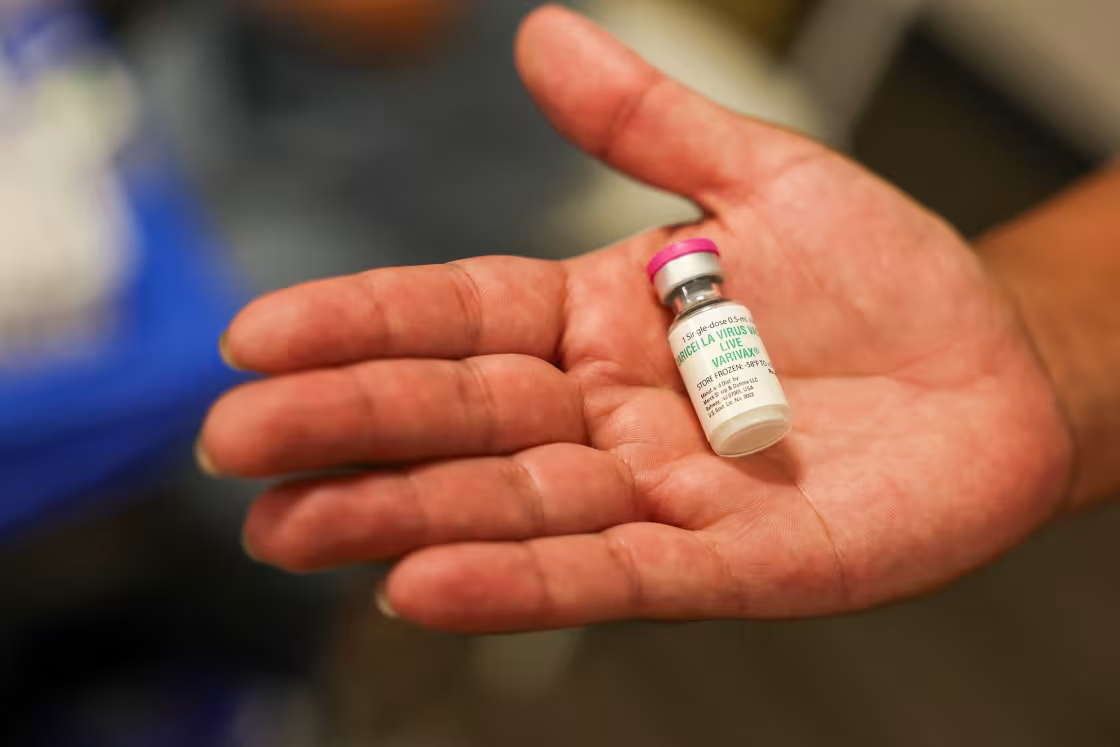 A person holds a vial of the Varivax vaccine, which protects against chickenpox, in Los Angeles on Oct. 24. (Patrick T. Fallon / AFP via Getty Images)
Autism and Aluminum
The shot that anti-vaccine activists most frequently and erroneously associate with autism — the combination measles, mumps and rubella vaccine — also does not contain aluminum salts.
Study on Aluminum and Neurodevelopmental Disorders
A study of more than 1.2 million children in Denmark, published in July in the journal Annals of Internal Medicine, found no link between aluminum salts from vaccines and neurodevelopmental disorders, including autism.
Kennedy’s Claims
But Kennedy — who has made unsubstantiated claims that aluminum in vaccines is linked to rising rates of allergies and autism in children — demanded the paper be retracted.
Conclusion
The current childhood vaccine schedule in the U.S. is backed by powerful evidence in terms of safety and effectiveness. Despite concerns about aluminum salts, numerous studies have found no link between aluminum in vaccines and neurodevelopmental disorders, including autism.
FAQs
Q: What are aluminum salts used for in vaccines?
A: Aluminum salts are used as an adjuvant to boost the body’s immune response to a vaccine.
Q: Are aluminum salts safe?
A: Yes, numerous studies have found aluminum salts to be safe for use in vaccines.
Q: Is there a link between aluminum salts and autism?
A: No, numerous studies have found no link between aluminum salts and autism.
Q: Why are some experts concerned about the investigation into aluminum salts?
A: Some experts are concerned that the investigation into aluminum salts may be part of a broader push to restrict access to or approval of some childhood shots.

