


Anxiety over School Admissions: A Growing Concern for Parents of Young Children
Deciding where to send your child to kindergarten has become one of the most high-stakes moments in many American families’ lives. A few factors have made selecting an elementary school particularly challenging in recent years. For one, there are simply more schools for parents to pick from over the past few decades, ranging from traditional public and private to a growing number of magnet and charter programs. There are also new policies in some places, such as New York City, that allow parents to select not just their closest neighborhood public school but schools across and outside of the districts where they live.
Introduction to School Choice
As a scholar of sociology and education, I have seen how the expanding range of school options – sometimes called school choice – has spread nationwide and is particularly a prominent factor in New York City. Shifting policies such as school choice give parents more school options than they had a few decades before.
Children arrive for class at an elementary school in Brooklyn in 2020. Angela Weiss/AFP via Getty Images
Navigating Schools in New York City
Every year, about 65,000 New York City kindergartners are matched to more than 700 public schools. New York City kindergartners typically attend their nearest public school in the neighborhood and get a priority place at this school. This school is often called someone’s zoned school. Even so, a spot at your local school isn’t guaranteed – students get priority if they apply on time. While most kindergartners still attend their zoned schools, their attendance rate is decreasing. While 72% of kindergartners in the city attended their zoned school in the 2007-08 school year, 60% did so in the 2016-17 school year.
Pressure to be a Good Mom
Many of the mothers I interviewed from 2015 through 2019 said that getting their child into what they considered a “good” school reflected good mothering. Mothers took the primary responsibility for their school search, whether they had partners or not, and regardless of their social class, as well as racial and ethnic background. In 2017, I spoke with Janet, a white, married mother who at the time was 41 years old and had an infant and a 3-year-old. Janet worked as a web designer and lived in Queens. She explained that she started a group in 2016 to connect with other mothers, in part to discuss schools.
Pressure to Find an Inclusive School
Regardless of their incomes, Black, Latino and immigrant families I interviewed also felt pressure to evaluate whether the public schools they considered were racially and ethnically inclusive. Parents worried that racially insensitive policies related to bullying, curriculum and discipline would negatively affect their children. In 2015, I spoke with Fumi, a Black, immigrant mother of two young children. At the time, Fumi was 37 years old and living in Washington Heights in north Manhattan. She described her uncertain search for a public school.
Pressure to Find a Niche School
Many of the parents I interviewed who earned more than $50,000 a year wanted to find specialty schools that offered advanced courses, dual-language programs and progressive-oriented curriculum. Parents like Renata, a 44-year-old Asian mother of four, and Stella, a 39-year-old Black mother of one, sent their kids to out-of-neighborhood public schools.
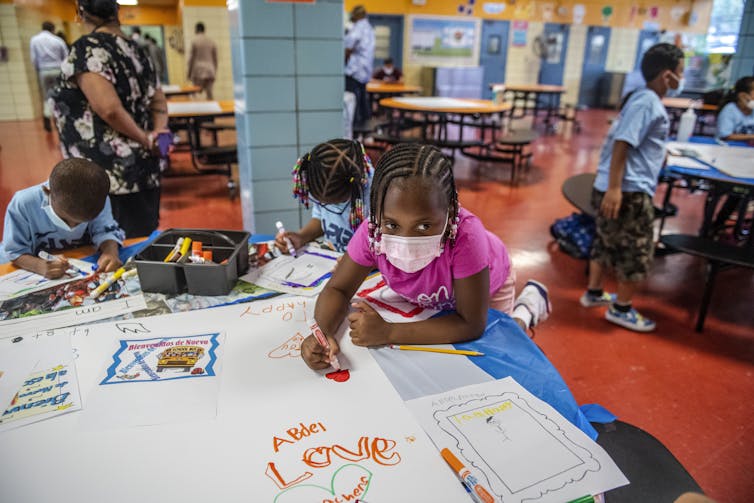 Students write down and draw positive affirmations on poster board at P.S. 5 Port Morris, a Bronx elementary school, in 2021. Brittainy Newman/Associated Press
Cracks in the System
The parents I spoke with all live in New York City, which has a uniquely complicated education system. Yet the pressures they face are reflective of the evolving public school choice landscape for parents across the country. Parents nationwide are searching for schools with vastly different resources and concerns about their children’s future well-being and success. When parents panic about kindergarten, they reveal cracks in the foundation of American schooling. In my view, parental anxiety about kindergarten is a response to an unequal, high-stakes education system.
Conclusion
Anxiety over school admissions is a growing concern for parents of young children. The pressure to find the right school can be overwhelming, and it is not limited to college admissions. Parents of elementary school-age children are also feeling the pressure, and some are experiencing it more acutely than others. The expanding range of school options, shifting policies, and the desire for a "good" school have all contributed to this anxiety. It is essential to recognize the cracks in the system and work towards creating a more equitable and inclusive education system.
FAQs
Q: What is school choice, and how does it affect parents?
A: School choice refers to the ability of parents to select the school their child attends, rather than being limited to their local public school. This can create pressure for parents to find the "right" school, particularly in areas with a wide range of options.
Q: How do mothers experience pressure in the school search process?
A: Mothers often feel that their choice of school reflects their ability to be a good mother. They may take on the primary responsibility for researching and selecting schools, which can be a source of stress and anxiety.
Q: What are some of the factors that contribute to parental anxiety about kindergarten?
A: Factors such as the desire for a "good" school, concerns about racial and ethnic inclusivity, and the need for specialty programs can all contribute to parental anxiety about kindergarten.
Q: How can we address the cracks in the education system revealed by parental anxiety about kindergarten?
A: Recognizing the inequality and high-stakes nature of the education system is the first step. From there, we can work towards creating a more equitable and inclusive system that provides all children with access to quality education, regardless of their background or zip code.

